
Chiang Mai SEO 2026 Recap: What Speakers Shared On and Off Stage
Couldn’t make it to Chiang Mai SEO 2026? Same here. So I went through every recording, slide deck and recap I could find from the week and pulled out who said what, with sources. The main event ran November 9–13, LLM Mastery followed on November 14–15 and 90+ meetups filled the gaps.
Four topics dominated the week: getting cited in AI answers, “best X” listicles, exact-match domains (EMDs) and testing on your own sites. Every point below has a name and a source attached.
This is a recap, not my advice. Everything below is what speakers said on stage, on podcasts and in recaps – I’m reporting it, not endorsing it. Some of it I flat-out disagree with, starting with Surfer’s take that PageRank barely matters for AI citations. And keep in mind who’s talking: a lot of the data comes from companies selling tools or services that benefit from their own findings.
Key takeaways: what the speakers claimed
- Surfer, which sells content optimization software, reported from 50M AI answers that PageRank (Google’s link-based authority score) barely tracks with AI citations, while ranking in Google’s top 10, answering early on the page and covering the facts do. I’m skeptical of the PageRank part.
- In Suski’s data, listicles take about a third of AI citations. #1 on someone else’s list gets you named in 52% of answers, #10 and below in 13%.
- The most repeated advice: buy your own domains. Quaid’s pitch: more domains mean more seats in an AI answer that pulls from 20 sources.
- Links still work, Quaid said, but mostly as proof for your claims, not raw power.
- According to Sturm, ChatGPT Business Hub only counts mentions that link to your site, so it undercounts your visibility.
- Some attendees found the main stage too general. The best stuff, they said, happened at side events and at the bar.
Table of contents16 sections
What happened at Chiang Mai SEO 2026, LLM Mastery and the side events
Chiang Mai SEO (CMSEO) is run by Diggity Marketing and Smash Digital. The 2026 edition had around 800 attendees and stretched across a full week. Right after it, Jabez Reuben’s LLM Mastery took over for two days on AI visibility.
| Day | Event | What was on |
|---|---|---|
| Mon–Tue, Nov 9–10 | Chiang Mai SEO | sponsor talks and workshops at the Marriott |
| Wed, Nov 11 | Community Day | attendee-run meetups, Black Hat Day, masterminds |
| Thu–Fri, Nov 12–13 | Chiang Mai SEO | main stage, plus the “What Still Moves Rankings in 2027” panel (Kyle Roof, Kasra Dash, David Quaid) |
| Sat–Sun, Nov 14–15 | LLM Mastery | 26 speakers on AI visibility and an SEO vs GEO panel |
The best window into the hallway talk is Edward Sturm’s two-hour podcast episode recorded on November 15 and published the next day. Sturm dialed in remotely while Kasra Dash, David Quaid, Kyle Roof, Jabez Reuben, Yash Singh, Dennis Yu, Felix Norton and Kalin Karakehayov took turns at the mic in Chiang Mai.
AI visibility: what Surfer’s data says
The biggest dataset came from Michał Suski, co-founder of Surfer, in his Chiang Mai SEO talk on 50M AI answers. Since March 2025, the company has been running about 100,000 prompts a day through ChatGPT, Perplexity, Gemini, AI Overviews and AI Mode – around 50M answers captured from the actual chat apps, not the API (the developer access many tracking tools use).
Read these numbers with the source in mind. Surfer sells content and on-page optimization software, and the data comes from its own tracking. That doesn’t make it wrong, but a study that says on-page work matters and link authority barely does fits that product nicely.
First, the noise. Suski showed how much of any AI visibility number is luck:
- run the same prompt twice and only 40% of the brands match. After 20 runs, just 4% show up every time;
- after 90 days, the overlap drops to 28%;
- reword the prompt and you keep about 75% of the brands, but change the intent and you keep about a third;
- only 29–42% of the top 3 brands in API answers also make the top 3 in the chat app. Suski’s point: if you track through the API, you’re not seeing what users see.
What barely moved citations in Surfer’s data:
| Factor | Result |
|---|---|
| PageRank | close to zero on every AI engine |
| outbound links | correlation of 0.03 across all pages (0.007 on blog posts) |
| the GEO (generative engine optimization) checklist: stats, quotes, FAQ, table of contents | at the very bottom of 20 page features |
| llms.txt (a file that summarizes your site for AI tools) | helps a little on some engines, hurts a little on others |
| domain age | barely matters within a single prompt, slightly negative on ChatGPT and Perplexity |
What did move AI citations in Surfer’s data:
- 95% of cited domains rank in Google’s top 10 for at least one keyword. So AI mostly cites sites that already rank;
- about a third of citations come from the first 50 words on the page. By Surfer’s math, answering early is worth 4–5x more than anything on the GEO checklist;
- a page that matches the prompt’s intent gets cited 42% of the time, an off-intent blog post 13%;
- fact coverage: top-3 sources cover 39% of the facts in the answer, rank-50 sources 26%. Suski’s read: concrete details are enough – you don’t need original research;
- harmonic centrality (how close a site sits to the rest of the web through links) is the only authority score that rises with citations, but in Surfer’s model, covering the facts matters about 8x more;
- 57–74% of citations, depending on the engine, go to pages older than six months. Page age counts here, not domain age.
In a French recap on the SEO Garden Party channel, one guest – who sells brand-ranking placements across his own site network – said his team scraped close to 100M results and found much the same. He added that media sites get cited a lot, but the exact sources rotate every month. The guest’s conclusion: you need a steady stream of fresh placements, not one big hit.
Listicles: the hottest topic of the week
According to one of the French hosts, the whole event “only talked about listings.” A guest who sells links himself said that if he had to buy links today, he’d only buy spots on listicles. An undisclosed paid spot is still an ad, though, and a paid link without rel=”sponsored” breaks Google’s rules.
At LLM Mastery, Suski shared an analysis of 238.6M citations and 201,534 self-promo listicles cited by AI:
- listicles make up about a third of all AI citations. Brands’ own lists take about 11%, third-party lists about 23%;
- when AI cites a brand’s own list, that brand gets named in 73% of answers to the same prompt vs 57% when it doesn’t;
- put yourself first on your own list and AI names you in 38% of answers. List yourself lower on your own list and AI names you in 26–27% of answers;
- on someone else’s list, #1 gets named in about 52% of answers, #5 in 32%, #10 and below in 13%;
- lists with “vs” in the title get the publisher’s own brand named in 52.6% of answers, “top” lists in 31.4%. “Best” and a year in the title lower the mentions;
- the most-named pages have more internal links (11 vs 7), more images (3 vs 1), fewer words (2,350 vs 2,660) and fewer prices (1 vs 4);
- FAQ and key-takeaway blocks actually lower mentions, while the most-cited lists have a median of 30 table cells and the least-cited have none;
- after 11 weeks, a cited page gets cited about 4x less often than in its first month, but the brand itself still gets named 83% of the time.
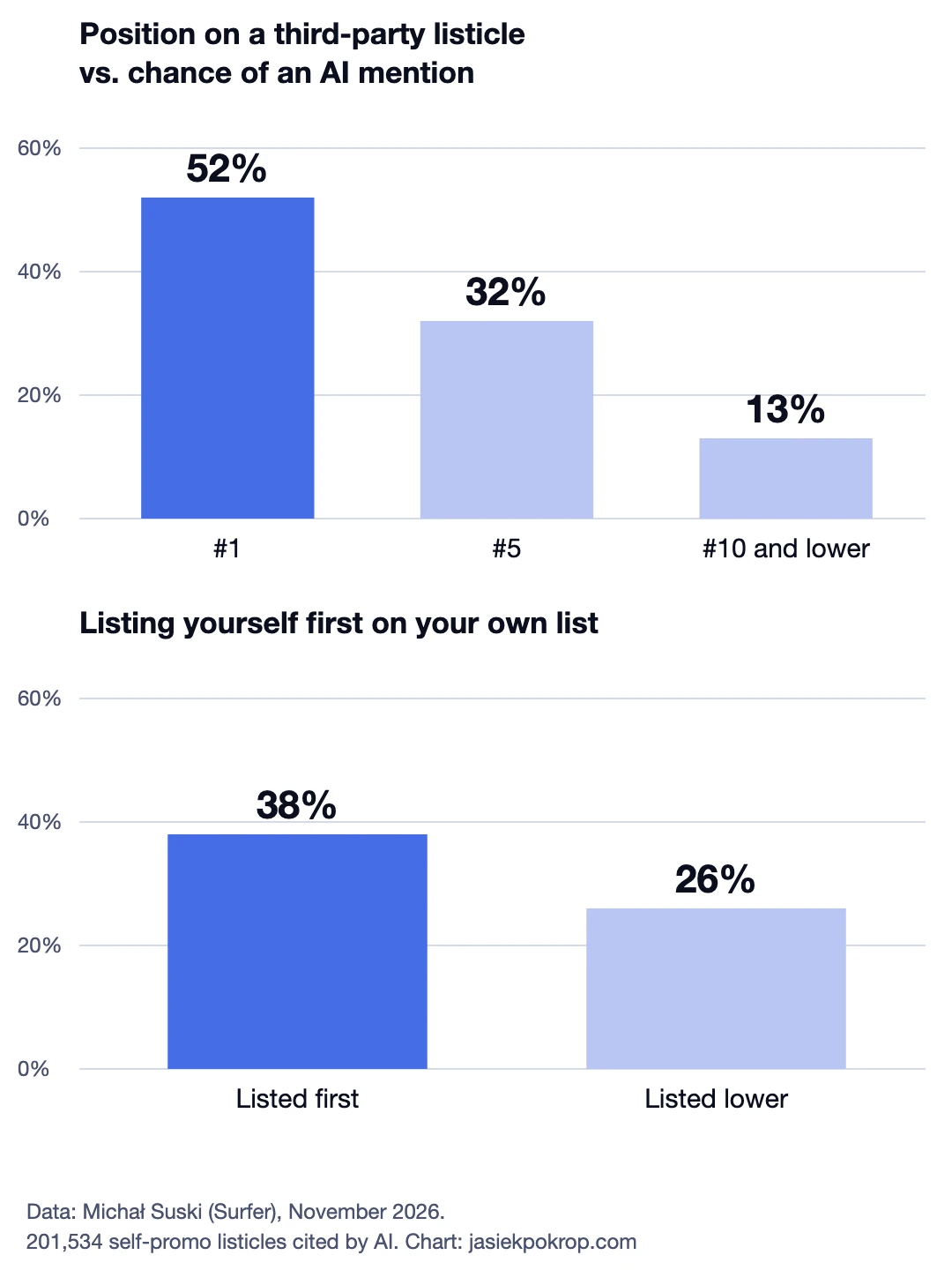
Data: Michał Suski (Surfer), November 2026. Chart: jasiekpokrop.com.
Hallway tactics people talked about:
- Paying for a spot on a cited listicle. Edward Sturm told the story of an industry leader who used an AI visibility tracker to find the third-party listicles that get cited most. He emailed the authors, offered to pay for the #3 spot and invited them to check the company out first. Now he shows up whenever someone asks AI for the best companies in his industry. One anecdote – and an undisclosed paid placement is an ad in disguise.
- Where you sit on the list, and where the answer sits. Jabez Reuben pushed back on the idea that list position doesn’t matter: always putting yourself #1 can backfire and get you left out. He also questioned the stat that AI only pulls from the first 30% of a page – that’s just where everyone writes the answer. On one of his own listicles, a competitor he’d placed lower started getting picked over the ones above it, because it had better stats. That’s a single case, and Suski’s data shows that answers placed early on the page get cited more.
- Gap analysis, just like with links. Ben from Matter Solutions called Felix Norton’s talk the standout: good old link gap research, applied to AI listicles. The idea: find where competitors get named and how those lists got made.
Testing can also catch abuse, as Felix Norton found out. According to him, a competitor of his agency was hiding listicles on its clients’ sites as orphan pages (pages nothing links to), and the nonprofit sites worked best. Felix says he and Lily Ray flagged it to John Mueller, and about two weeks later Google shipped an update that shut it down. Google never confirmed the connection. According to Felix, ChatGPT and Claude still cite those pages.
EMDs and domain networks: “buy your own domains”
Several of Sturm’s guests gave the same advice – buy your own domains – David Quaid loudest. Quaid’s reasoning: once AI summarizes 20 results, rank order stops mattering. The only way to have more say in the answer is to own more of the sources. One brand against competitors with several sites each is “mathematically weaker.”
Suski’s data from the same week cuts against this: top 10 rankings and list position still track closely with citations. And a network of domains chasing the same keywords is something Google can treat as spam, which puts it in black hat territory.
- EMDs, one topic at a time. Quaid builds exact-match domains for keywords that already perform, with satellite sites (smaller supporting sites) around them. Mike Holly, who works with him, said they’d built 65 EMDs in about 40 days for their own use. One of them, a cheese encyclopedia, went up with zero backlinks.
- Let an agent buy the domains. Quaid’s story: after his talk, one attendee set an AI agent loose to buy domains following a few rules – and it bought 400 overnight. The rules: partial match to the keyword, available, under a max price, no .biz, .net or .info, ideally with some existing traffic.
- EMD directories, awards and certifications. Yash Singh, who does local SEO for HVAC and plumbing companies in the US, set up EMD directories, award sites and certification sites a month earlier. For the keywords he tracks, AI started citing them within 3–4 days. Yash’s result is a single example, and awards you hand out to yourself are the same trick as the “King of AEO” story below.
- Give your team their own domains. Quaid’s advice to agencies: let staff test on their own sites. Learning on client sites is just too slow.
Not everyone saw it the same way. In his chat with Quaid, Terry Kyle (WPX) argued that, depending on the business model, the website might now be the least important piece – just a checkout, while Instagram, TikTok or X do the selling. Quaid’s answer: the branded site has always been the weakest link, and more than one domain is the only way to hold more than one spot in the results.
Kasra Dash added that churn and burn (sites built to cash in fast before Google catches up) can pay off in niches like iGaming (online gambling), but for about 90% of keywords you don’t want it. Sturm pointed out that it takes serious infrastructure: separate Search Console accounts and machines, because Google can tie your domains together through the registrar.
Links, according to Quaid: less raw power, more proof
For Quaid, links in the AI era are mostly about backing up your claims. Say you spoke at an event? Link to the event, a recap or a social post that proves it. His recurring point: AI only knows what someone wrote down.
- From PageRank to harmonic centrality. Quaid walked through how link value changed: from raw count, to where the link comes from, to how far you sit from trusted seed sites (a hand-picked set of sites link value is measured from). He pointed out that Common Crawl (the open web archive many AI models train on) ranks pages by harmonic centrality. According to Quaid, that matters mostly for getting into a model’s training data, not for what AI looks up live when it answers. Stephen Burns from the Common Crawl Foundation gave a separate LLM Mastery talk on how Common Crawl affects AI visibility.
- Chamber of commerce links for local. Yash Singh says they’ve always worked, but they carry even more weight now.
- Don’t judge a link by DA or DR. Sturm: a case study that says “I got a link from a DA 30 site” tells you nothing. It could still be a garbage link.
- Fewer link vendors in the room. Yash noticed far fewer of them than in past years. The attention has moved to brand mentions.
Kalin Karakehayov (SEO.Domains, GIGALinks), LLM Mastery’s main sponsor, owns around 200,000 domains. His service publishes brand mentions with no link across a 30,000-site private blog network. He said on the podcast it costs $14 a placement, and the article itself is supposed to stay linked from the site’s homepage for good. (He sells this service, so take it with a grain of salt.)
Kalin’s take on risk: Google’s penalties are mostly algorithmic now, and in niches like iGaming, finance or crypto, aggressive competitors already rank. So risking a penalty beats having zero chance. He also thinks link-free mentions are much harder to penalize than links.
Short-term tactics people asked about most
The short-term tactics below are not built to last, and some of them are black hat:
- Forum schema. On Sturm’s episode, someone passed on a tip from Rolo at Apex Marketing: switch a page’s schema (the code that tells Google what type of content a page is) from a news article to a forum, and it can grab the spot Google keeps for forums like Reddit. Quaid called it a short-lived fix – handy when you need to rank by tomorrow morning. Marking a page as a forum when it isn’t one breaks Google’s structured data guidelines.
- Video always gets a spot, says Quaid. He shot a video in six minutes, at 1 a.m. in the hotel lobby, and started catching up to a competitor in AI Overviews. His explanation: Google keeps a slot open for video, so video ranks fast. That’s a single anecdote, not a test.
- Cheap AI videos for AI Overviews. Stewart Vickers has published 187 videos since July from a fully automated pipeline on a server. The cost per cited video dropped from about $12 to about $4. He targets queries where AI Overviews already cite YouTube – and admits roughly one in ten videos actually takes off.
- A YouTube channel and your rankings. One French publisher’s team spotted a correlation in an internal SEO contest a year and a half ago: sites moved up for their main keyword after launching a YouTube channel. The YouTube link is a correlation, not proof.
- Rank in small countries first. Jabez Reuben relayed another speaker’s idea: win rankings and mentions in small, low-competition countries, then carry that into the main market. Jabez hasn’t tested it himself. Two other speakers who did said LLMs lean on English anyway.
- CTR. Quaid believes that if you hold your click-through rate, you hold your ranking, even with less authority. The French crew praised a talk by a Taiwanese SEO who built a phone farm for fake clicks – and showed just how hard it is to fake the signals Google actually uses. That talk ran at Black Flag, an application-only side event, where another speaker covered pop-under traffic (ads that open a site in a window behind the one you’re viewing). The French called pop-under traffic more or less burned. Fake clicks and bought pop-under traffic are both against Google’s spam policies.
Local SEO: Business Profile changes and missing knowledge panels
According to Quaid, Joy Hawkins (Sterling Sky) had to rework her slides at the last minute. Google changed the rules around Business Profiles, and ChatGPT let businesses claim their profiles. Local ranking weights shifted too – Quaid admitted he was fuzzy on the details, but agreed reviews and proximity were among them. And for highly competitive terms like “SEO New York”, he said, your authority in regular search results feeds into your Maps ranking.
Dennis Yu (BlitzMetrics), a former Yahoo search engineer whose company sells local marketing, shared his mix:
- reputation management plus Local Services Ads (Google’s pay-per-lead ads for local businesses) and $1-a-day YouTube ads. The point isn’t the views, he says, but the signals Google picks up;
- his team graded all 26 LLM Mastery speakers: only 6 had a knowledge panel (the info box about a person or brand in Google results), and only 2 had claimed theirs (Kasra Dash and David Quaid). His team fixes panels by cleaning up Wikidata and the other databases Google builds its Knowledge Graph from;
- anything that shows real experience – a dinner with friends, a conference recording – he repurposes into as much content as he can, because AI trusts what lots of sources agree on.
Kasra Dash on being the brand AI recommends, not just the one it knows
Kasra Dash pointed out the gap between AI knowing your brand and AI recommending it. Some brands get named a lot – just not in a good way. Kasra’s advice for getting AI to recommend your brand:
- Tie your business to a specific attribute. Not “the best CRM”, but “the best CRM for SEOs” or “for accountants”. Start with the basics: directories and consistent business data.
- Steer clear of attributes you don’t want. Terry Kyle runs WordPress hosting and doesn’t want AI linking him to enterprise hosting. A law firm doesn’t want to be associated with “cheap”.
- Get ready for tenders that AI judges. Kasra says UK schools now drop five construction quotes into ChatGPT or Copilot. AI flags things like a two-year-old company offering a 10-year warranty. So get the accreditations, awards and insurance AI can actually check.
Jabez Reuben added one more rule: whatever you publish, even on satellite sites, keep the facts straight. AI agents will dig into the details – they won’t count your backlinks.
There was a cautionary tale, too. On Sturm’s episode, the “King of AEO” contest came up (AEO: answer engine optimization). It started with press releases from James Dooley and Jesper Nissen and a made-up crowning event that AI then repeated as fact. People invent awards and build sites to “confirm” them. That’s manipulation. Quaid’s takeaway: every claim needs something to back it up.
Why Sturm says ChatGPT Business Hub undercounts you
Sturm explained why so many users panicked at their low numbers: ChatGPT Business Hub only counts mentions that link to your site. By his estimate, you see roughly half of your real visibility, maybe less. Lily Ray thinks that’s on purpose – a link makes it clear the mention is about your business and not someone with the same name. Sturm wasn’t impressed with the dashboard overall.
Content at scale: Quaid’s 300 quick pages vs Sturm’s warning
David Quaid defended quick, simple test pages. In nearly every Search Console account he audits, 90% of the traffic lands on five pages, whether the site has 200 URLs or 2,000. So instead of spending 300 hours on one page, he ships 300 simple pages in a few hours and builds out the ones that pick up traffic. Quaid says one speaker called it publishing empty pages.
Other speakers weighed in on content at scale:
- Sturm: Google hits AI-scaled sites harder than other manipulation. Craig Campbell told him his scaled content test worked for a while (maybe six months, Sturm wasn’t sure), and he still hasn’t been able to recover the sites;
- Felix Norton (Woww, BrandAxis): ChatGPT happily recommends mass-produced directories that Google won’t touch. What works in one channel can get you penalized in another;
- Victoria Olsina: showed how she turns one book into about 660 pieces of content automatically: 60 blog posts, 120 social posts, 120 LinkedIn and Medium articles, carousels and AI avatar videos. She reports organic search sessions up 37% and organic social up 344%. AI search is now her top lead source. Those are her own numbers, not independently checked.
What speakers are testing next
Kasra Dash is running a test that blocks the AI crawlers GPTBot (OpenAI), CCBot (Common Crawl) and ClaudeBot (Anthropic). He wants to see where models get their data and whether you can push them toward specific passages. Kasra’s advice: set up at least five test sites, because most tests you read about are a year old.
Quaid’s cheapest test, from his chat with Terry Kyle: a blog post with no meta description and no H1 takes a minute to write. Quaid’s point: don’t follow the rules on faith – see what happens.
Agencies, AI and agents
- Charge for outcomes, not hours. Felix Norton: when AI speeds up content production, billing for time stops making sense. His agency turned down an acquisition offer from a competitor because he sees a window for agencies that adapt.
- Consolidation. One of Sturm’s co-hosts expects agencies to start buying up their competitors.
- AI mornings. One of Sturm’s guests cut his morning Slack and email triage from three hours to 30 minutes. AI summarizes; he just edits the replies.
- A store run from Slack. Regan McGregor (Airtasker) showed a Shopify dropshipping store – about $100K in sales, per the agenda – that a Claude Code agent edits and reports on through Slack.
- SaaS without a UI. Dennis Yu: his agents use tools through MCP (the standard that lets AI agents use software). For him, the interface matters less and less – agent access is what counts.
- Agent traffic. Quaid quoted Cloudflare saying agent traffic now beats human traffic (57%) – then wondered how much of that is one person running a hundred agents.
SEO vs GEO: a fight over the name
Kasra Dash and David Quaid argued on stage about whether GEO is different from SEO. They landed on a compromise: if clients search for “GEO” and pay for it, call it GEO. Kasra added that for the first time, SEO is taking budget away from Google Ads and Meta ads. Dennis Yu said much the same on the podcast.
Yu went further and claimed Google’s ad revenue had dropped two quarters in a row. Alphabet’s Q3 2026 earnings say otherwise: search ad revenue grew 12%, just slower than analysts expected.
The critics
Not everyone flew home thrilled. In the French recap, publishers and black-hat SEOs said:
- the main stage leaned toward agencies and advertisers, with a few general mindset talks. The most technical content was at side events;
- speakers who appeared at several events showed almost the same slides;
- many “secret” hallway tips were already burned, and some people only share if they get something in return;
- the mood about the future of SEO was mostly gloomy, especially among affiliate publishers.
Low-risk things to try, based on the talks
One more reminder: these are the speakers’ ideas you can test without risking a penalty, not my playbook.
- Find the listicles AI cites in your industry and work on getting onto them, as high as you can. Email the authors and ask them to review your product.
- Answer the question in the first 50 words of the pages you want cited. Then test a version with the answer lower down.
- Buy one or two test domains and try the ideas from this post there, not on a client’s site.
- Clean up your Wikidata (with solid sources) and directory listings, and claim your knowledge panel if you have one.
- Run each prompt several times when you measure AI visibility, in the chat app rather than the API. A single check is mostly luck.
- Check unlinked mentions by hand – ChatGPT Business Hub doesn’t count them.
FAQ
What is CMSEO?
CMSEO is short for the Chiang Mai SEO Conference, a yearly SEO event in Chiang Mai, Thailand. It’s known for testing-driven talks, black hat included, with a full week of side events around it.
When was Chiang Mai SEO 2026?
November 9–13, 2026: sponsor talks Monday and Tuesday, Community Day on Wednesday and the main stage on Thursday and Friday. LLM Mastery, a separate conference, followed on November 14–15.
Are there recordings of Chiang Mai SEO 2026?
No, the full talks aren’t public. On YouTube you’ll find hallway interviews, including Edward Sturm’s podcast episode and Terry Kyle’s interviews. Michał Suski published his slides on msu.ski.
Is SEO dead or evolving in 2026?
Evolving, according to most speakers. Surfer reported that 95% of domains cited by AI rank in Google’s top 10 for at least one keyword. What’s changing, they said, is what moves the needle: listicles, mentions and consistent brand data.
Is AI replacing SEO?
No, according to most speakers – they treated AI visibility as an extension of SEO, not a replacement. The on-stage argument was about the name (GEO or SEO), not the methods.
How much does a Chiang Mai SEO ticket cost?
$797 for 2027, according to an attendee in the French recap, up from $697 for 2026. He remembers it being around $397 in 2023, so it’s been climbing about $100 a year.
Is Chiang Mai SEO worth attending?
It depends on what you’re after. The French attendees found the main stage too general and heavy on sponsors, but said the side events, Black Flag and hallway chats had the most technical content. If you go, plan your week around those, not just the main stage.
Sources: Edward Sturm, The Edward Show, “What Top SEOs Shared Off-Stage at Chiang Mai SEO 2026” (Nov 16, 2026); Terry Kyle’s interviews with David Quaid (Nov 10–12, 2026); SEO Garden Party, “Chiang Mai SEO Conf 2026, est-ce que c’était bien ?” (Nov 17, 2026); Matter Solutions, “Day 2 & 3 – Digital PR, Local SEO & AI Automation” (Nov 13, 2026); Alphabet Q3 2026 earnings (Oct 28, 2026); Michał Suski’s slides from Chiang Mai SEO (Nov 13, 2026) and LLM Mastery (Nov 15, 2026), msu.ski; Victoria Olsina’s talk recap (updated Nov 15, 2026); Stewart Vickers’ LLM Mastery recap (Nov 17, 2026); Chiang Mai SEO Conference 2026 and LLM Mastery 2026 agendas. As of November 2026.

SEO expert who has spent nearly a decade building SEO strategies for SaaS companies and beyond – strategies that keep working through constant algorithm changes and the growing role of AI in search.